
Your Intimate Elopement Day in Japan: A Guide for Couples

Updated: Sep 17
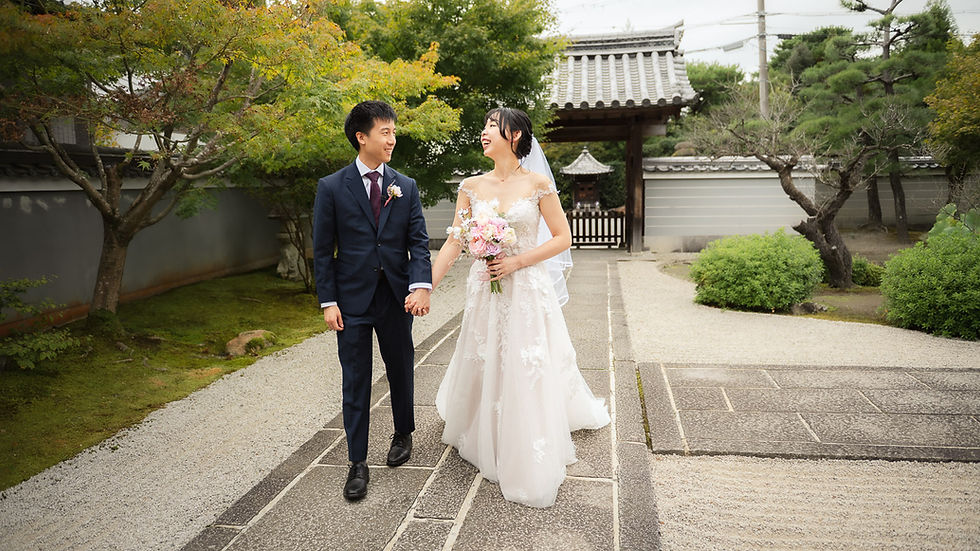
If you’re planning an elopement in Japan — especially if it’s your first time visiting — one of the hardest things to visualize isn’t the venue or the photos. It’s the day itself.
Where do you need to be?
Who is with you, and when?
How much of the day is structured — and how much simply unfolds?
Many couples are surprised by how different the planning process can be here. We explain why eloping in Japan works a little differently in more detail here.
This guide walks you through what happens on an elopement day in Japan, from arrival through to the end of the celebration. While no two elopements are identical, the flows below reflect how days usually unfold when they’re planned carefully and managed quietly in the background.
We’ll look at two common scenarios: eloping in Tokyo and eloping in Kyoto. The principles are the same, but the experience — and the logistics — are quite different.
Before the Elopement Day: Arriving in Japan
Once you arrive in Japan and check in to your accommodation, we ask you to send us a quick WhatsApp message to let us know you’ve arrived safely.
From that point onward, WhatsApp becomes our primary way of staying in touch. We use it for:
Last-minute questions
Light travel or dining recommendations
Small timing adjustments
Emergency communication (typhoons, earthquakes, transport disruption)
It’s simple, immediate, and reassuring — especially if Japan is unfamiliar territory.
A Calm Morning
One practical note we always share: if possible, keep the morning of your elopement calm. Have a proper breakfast, drink water, and avoid squeezing in sightseeing beforehand. The day flows far more smoothly when you start rested and unhurried.
What Happens on an Elopement Day in Japan: Tokyo at a Glance
Before going into detail, here’s the typical flow of a Tokyo elopement day:
Arrival at the venue and orientation
Hair and makeup begins (couple kept separate)
Groom downtime while story details are captured
Bride ready → optional first look
Ceremony
Private post-ceremony pause
Post-ceremony photos (tea ceremony if included)
Optional city shoot and close of day
Below, we explain how each part of the day actually unfolds — and why it’s structured this way.
A Tokyo Elopement: How the Day Unfolds
Given the vast expanse of the city, a Tokyo elopement is usually venue-anchored and contained. Most of the day takes place in one primary location, which creates a calm, predictable rhythm — particularly reassuring for first-time visitors to Japan.
Arrival & Orientation
We meet you either directly at the venue or at a nearby agreed location and escort you in together. Once inside, we take a few minutes to orient you: where things will happen, where personal items can be left, and what the next four or five hours will look like.
Hair and makeup begins setting up at this stage, but nothing feels rushed. The aim here is simply to arrive, settle, and let the space become familiar.
Getting Ready (Separately, by Design)
Once preparations begin, we quietly separate the bride and groom.
This isn’t about enforcing tradition — it’s about pacing and headspace. The bride begins hair and makeup in a private area, while the groom has time to practice vows, sit with his thoughts, or simply take in the surroundings.
Some grooms prefer to be alone at this stage; others like company. Either way, no one is left wondering where they should be or what they should be doing.
While this is happening, the photography and video team begin capturing the story layer of the day: the quality of the light, textures of the venue, small details, and candid moments. These are the elements that quietly shape the final record of the day.
The Transition Moment
Once hair and makeup is complete, we ease into the next phase rather than jumping straight into the ceremony.
The bride usually steps aside briefly for a few solo portraits — a calm moment to adjust and arrive fully. From there, many couples choose to do a first look. This is a simple reveal: no audience, no pressure. Just a grounding moment before the ceremony (and extra variety in the final photo album). Some couples choose to skip this entirely; the flow works either way.
The Ceremony
The ceremony itself is unhurried and focused. Because everything has already been coordinated, there’s very little to think about beyond being present.
Tokyo venues lend themselves to this kind of contained experience: minimal movement, fewer variables, and a strong sense of calm continuity.
A Pause — On Purpose
Immediately after the ceremony, we step back.
We do not rush you into photos or direct you elsewhere — but simply give you space. A few quiet minutes to let the reality of what just happened sink in, without instruction or interruption.
Many couples later say this pause becomes one of the most meaningful parts of the day. Without it, the experience can risk becoming a blur.
Post-Ceremony Photos & Wind-Down
Post-ceremony photography follows at an unforced pace. Depending on the venue and your preferences, this may include a tea ceremony, light refreshments, or simply moving through the space together.
Before leaving the venue, some couples choose to change — either to get comfortable for the evening ahead or in preparation for a planned post-venue photo shoot.
If planned in advance, the photographer may then accompany you into the city for a short post-ceremony shoot — a gentle transition from the intimacy of the venue to the wider energy of Tokyo.
As a guide:
Venue portion: approximately four to five hours
Post-ceremony city shoot: around 90 minutes to two hours
Nothing is timed to the minute. The structure exists to support the experience, not dictate it.
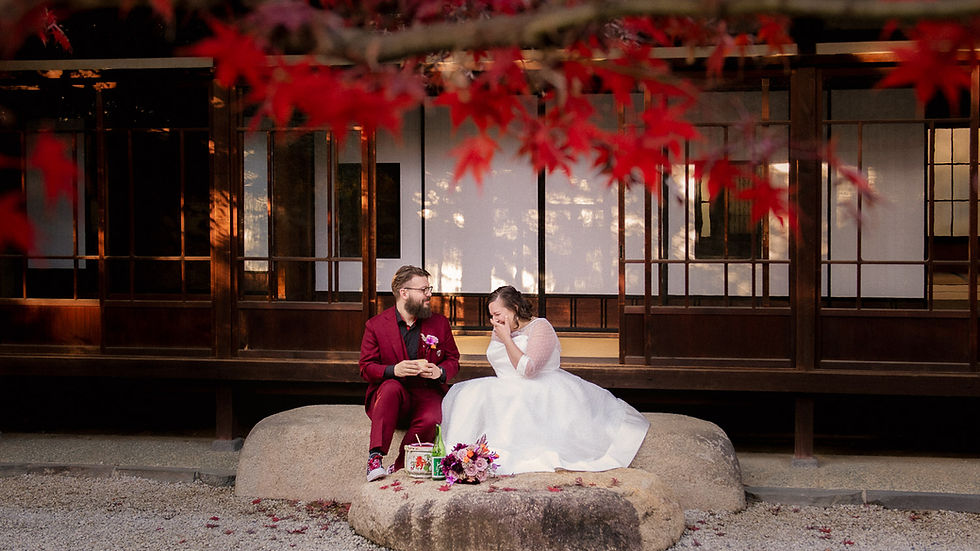
A Kyoto Elopement: At a Glance
Kyoto elopements follow a slightly different rhythm:
Meeting at your hotel or Airbnb
Hair and makeup begins (couple kept separate)
Groom departs first with photo/video team
Venue light assessment and solo groom portraits
Bride arrives → optional first look
Ceremony
Private post-ceremony pause
Post-ceremony photos (tea ceremony if included)
Return to accommodation and close of day
Below is how that typically feels on the ground.
A Kyoto Elopement: How the Day Unfolds
Kyoto is a much more compact city than Tokyo, so elopements here are more fluid and movement-based. Rather than being anchored to a single venue, the day unfolds across a sequence of locations, shaped by light, timing, and conditions.
Getting Ready at Your Accommodation
We meet you at your hotel or Airbnb. Permission for non-guests to enter is required, and this will have been arranged during the planning stage.
Once preparations begin, the bride and groom are kept separate, as much as the space will allow. Hair, makeup, and planning support take place in the room, and shortly after, the photographer and videographer arrive to begin capturing getting-ready moments and details.
Groom First, Then the Scout
The groom is usually ready first.
At that point, the groom, Ross, and the photo/video team head to the venue. This allows time to assess light and conditions on the day and identify the best location for a first reveal, if one is planned. A few solo groom portraits are taken during this stage.
Coordinating the First Look
The bride then follows with Ayako, who stays in constant communication with Ross to coordinate timing and positioning.
On arrival, the bride steps aside briefly for a few solo portraits before the first reveal. As with Tokyo, this moment is optional, unforced, and kept deliberately simple.
The Ceremony
The ceremony follows, shaped by the venue and the season. Kyoto ceremonies tend to feel gently paced, with a natural sense of progression rather than a fixed, contained structure.
Space After the Ceremony
As in Tokyo, we step back immediately after the ceremony. This quiet moment — free of direction — allows the experience to settle before moving on.
Post-Ceremony Photos & Wrap-Up
Post-ceremony photography may include a tea ceremony before the venue hire concludes. From there, we return to your accommodation, say our goodbyes, and leave you to end the day in whatever way feels right — whether that’s a celebratory dinner, a quiet walk, or simply resting.
A Final Note on Structure
This is a typical flow, not a rigid timetable.
Season, weather, venue rules, and personal preferences all influence how an elopement day unfolds. Our role is to manage those variables quietly so the day feels supported rather than controlled.
When it works — and when it’s planned properly — the structure fades into the background, and the experience feels natural, calm, and unforced.
If you’re also starting to think about budgets and priorities, we’ve broken down typical elopement costs in Japan here.
If you’re starting to picture this day on a calendar, timing and season make a real difference. We’ve written more about the best time of year to elope in Japan here.
If you’re dreaming of a unique and intimate celebration, Japan offers a stunning backdrop. With its rich culture and breathtaking scenery, your elopement day can be everything you’ve imagined and more! Let’s make it happen together!


Comments